


僵尸先生
机构调研丨人形机器人+国产替代+智慧矿山 这家公司积极打造第二增长曲线 已获头部新势力车企项目定点_我的网站

A | By Anna Dalla Valle (CNS)-- Forward-looking mindset: whole-system and life cycle thinking My work is centred on the environmental sustainability of buildings over the entire life cycle and beyond in view of the circular economy: from design and construction to use and reuse, up to final disposal or, preferably, recovery for a second life. Here, the paradigm shift is twofold, because a whole-system thinking is needed not only to consider the entire life cycle, but also to envision what happens next. The ultimate goal is to minimize environmental impacts and to drive both sustainability and innovation. To be more explicit, the first shift involves keeping in mind the entire life cycle – from the early design stages – moving beyond the traditional focus on construction and energy efficiency during use. It is to select building products looking back to the supply chain, such as recycled content, locally sourced and bio-based solutions, while also looking ahead to performance decay, maintenance needs and the potential for extending service life. Moreover, the second shift press to move beyond the linear building process – as traditionally practiced – in which we extract raw materials, we build, we use, and eventually we demolish. Indeed, this model has reached its limits, undermining planetary resources with adverse environmental and social effects. Interconnected choices: designing decisions that create shared value A life cycle perspective matched with circularity inevitably challenges this linearity, wondering from the very beginning about what happens when assets become obsolete and fall into disuse, to design buildings as part of a continuous loop of resources. Accordingly, design, construction, daily use (energy and water consumption), maintenance, replacement and end-of-life turn out to be regarded not as isolated steps but interconnected with each other. In fact, at each stage, choices can either preserve or destroy value. For example, if construction solutions are carefully selected, they can be reused in the future, either in their entirety, as whole products, or through disassembly into components, or even by separating materials. In this way, they may maintain the same function (e.g. a window reused as it is) or serve different purposes (e.g. glass cullet used as input for glass wool insulation). If technological systems are designed flexibly, buildings can reach different business segments and host concurrently different activities, resulting easily adaptable from housing to office and vice versa, instead of being demolished. If building processes integrate digital tools, data can guide smarter decisions over decades, provided that data infrastructure is ensured, followed by constant monitoring and analysis of the collected data and the update and dissemination of results across industry and practitioners as well as policymakers. Thinking this way means making choices future-oriented, ready to embrace innovation while respecting planetary boundaries, namely limiting the environmental impact at every stage and in every region – to avoid burden shifting – not just at the beginning but along the whole (first-second) life cycle. Certainly, a demanding but exciting challenge: one I am proud to take on and in my little to contribute to. Beyond appearances: close-up process for understanding what lies behind In daily life, we often say to "look beyond appearances". Usually, this expression pertains to people, to underline the risk of avoiding judging someone solely by what can be seen. Now the interesting thing is that the same advice can be applied to architecture, obviously without undermining the importance of aesthetic beauty, at the core also of the New European Bauhaus initiative together with sustainability and inclusion. Nonetheless, as an architect expert in sustainable technology, I have learned to extend it to the built environment, by seeing buildings not merely as visible structures (walls, roofs, windows), but as living parts of a larger and complex system. In this sense, architecture can be compared to a plant. Plants are anchored in the soil by roots; buildings are anchored in the ground by foundations. Plants capture sunlight, absorb water, accommodate small animals, and interact with other organisms; buildings consume energy, deplete water, host human life, and interact with their surroundings. Both are deeply connected to their ecosystem. However, to fully understand them, both must be looked beyond appearances, through a "close-up" process taken to the extreme. It is not simply a matter of focusing on details, as happens in photography and cinema fields; the intention is to delve deeper and deeper to the fuller extent: an in-depth analysis of whatever is behind, starting from the exterior to gradually shift to construction technologies, materials, up to their chemicals. The latter is, of course, not the responsibility of architects, but it lies at the heart of Life Cycle Assessment (LCA), analyses that I usually perform during the decision-making at the different process stage to help building stakeholders minimize environmental impacts across the entire – potentially multiple – life cycle. For architectural technology, for example, it is a matter of addressing, alongside conventional requirements (e.g. performance, safety, usability, well-being), the specific requirements of environmental sustainability (e.g. the rational use and optimization of materials, energy, water), taking into account the technical feasibility and evaluating the entire life cycle. At the utmost, it is to look into everything that underlies the presence of that specific material in that exact spot, its behaviour and interrelationships when in service, and its post-use journey, setting up the necessary network to actually close the loop in practice. Material-immaterial synergy: the invisible foundations of sustainable architecture To embrace this vision, the idea of resources is to be extended compared to the ordinary sense. Certainly, buildings are made and calls for a set of tangible resources, such as money to be started, bricks, steel, or timber to be erected, tools and equipment to be managed including in the long-term. The issue that often runs out is that buildings rely heavily as well on intangible resources, namely knowledge, skills, processes, organisation, information flows and network. These two dimensions – tangible and intangible – are closely connected and interdependent on each other. Without appropriate eco-design knowledge, even the best materials are wasted; without materials, knowledge has no application. In such a mindset, architecture becomes a remarkable expression of the synergy between tangible resources and intangible resources: a space where East and West can successfully meet, building a bridge across cultures through openness and inclusiveness. Indeed, it is well recognized that different traditions bring different perspectives and, when combined, generate the best and more holistic solutions. The "living building" is both a technical and cultural artefact, an expression of human creativity that must not overstep the planetary boundary. Strategic imperative: cross-border and cross-disciplinary cooperation Evidence is found in international collaborations such as Joint Schools, where universities from different countries join forces to promote shared research and training. A concrete example of Sino-foreign cooperation is the XJTU-POLIMI Joint School, opened in Xi'an (China) in 2019 through a partnership between Politecnico di Milano and Xi'an Jiaotong University. As POLIMI's first campus outside Italy, it serves as an international platform dedicated to education and research as well as technology transfer and business incubation. This initiative, like others currently in place, aims to take the best of each part to foster shared growth and mutual learning. Italy brings its strong polytechnic culture, its multidisciplinary approach and focus on design quality, together with the European emphasis on social and environmental responsibility. China, in turn, is a leader in fast-evolving business, in the integration capacity of digital technologies and in large-scale engineering projects, pulled by top-down policies that allow fast implementation. In conjunction, these strengths can create fertile ground for innovation and speed up the transformation process within the Architectural, Engineering and Construction (AEC) sector, always been acknowledged as resistant to change, due to its intrinsic complexity and fragmented nature. Rethinking the built environment: buildings as resource-driven assets The effort is to move beyond the concept of buildings as "material banks" – namely repositories where resources are temporarily stored – to rethink them and push the vision further of buildings as "resource-driven assets". While the first construct is earmarked for physical goods, that proposed calls for careful consideration of both tangible/material/visible resources and intangible/immaterial/invisible resources, taking care that everything is optimised and nothing is wasted, to preserve their value over time. In practice, this means looking at what goes into buildings, such as materials, systems and the energy required to transform and assemble them, but also, for instance, the set of expertise, skills and specialization of practitioners involved during design. Similarly, starting from the outset, it means looking at what comes out throughout buildings life, like emissions, waste, and decommissioned materials, but also knowledge gained from monitoring and lessons learned from operations. To ignore either side of the equation (inputs-outputs) would be a missed opportunity. If we want buildings to truly act as resource-driven assets, we must synergise, map, understand, and manage the full spectrum of in- and out- flows, both tangible and intangible. On the tangible side, this requires a deep understanding of material, energy and water flows across the entire life cycle. Which resources are extracted, transported, and assembled? How much energy is consumed, and how is it sourced? How do materials degrade over time, and how can they be reused or recycled without losing quality? These questions are essential to reduce impacts and to design systems that are both efficient and resilient. On the intangible side, equally important are the flows of information and knowledge that connect all actors in the construction value chain. Long before a building is erected, crucial questions are: How is data exchanged among stakeholders? Is communication efficient enough to speed up the workflows? How can design capabilities evolve into maturity, meaning quality achieved through best practice? Then, as more buildings themselves add to this immaterial layer through sensors, smart meters, and digital platforms that produce valuable insights, another set of questions follows: How is this information managed, shared, and preserved? How to ensure that data supports predictive maintenance and reverse logistics? How to activate new business models based on sharing and collaboration? Just as materials should not be wasted, neither should information. Data and knowledge must be treated as resources that enrich our collective know-how, building an "infodump bank" that not only improves current performance but also informs future decisions, guides new designs and strengthens subsequent projects. The correlation between tangible and intangible resources is ever closer: managing them together ensures that nothing is wasted and that the embedded value is preserved across time. In that respect, "no waste of resources" also means "no waste of value", since every material, every bit of data, and every piece of knowledge carries potential that, if carefully handled, can extend usefulness, inspire innovation, and create lasting benefits well beyond the life of a single project. Global impact: construction sector as global lever for planetary sustainability Through joint research and cross-border exchange programmes, the construction sector proves to be an extraordinary testing ground and given its global impact in terms of emissions and resource consumption, it clearly stands as a priority for change. Furthermore, never forget that buildings are everywhere and shape our daily lives, leading mindful planning crucial not only for preserving the natural environment but also human well-being. In this framework, architects, engineers, designers, scientists and all necessary professionals can work side by side to explore new possibilities, even creating new synergies across key business sectors. Imagine if constructions integrate materials from unexpected sources such as fashion and/or food waste. Fast-fashion clothing and textile scraps, invasive plants and agricultural by-products, or even organic waste – which are currently a significant environmental burden with serious social effects – can be rethought as valuable inputs for new building solutions. In this way, the concept of waste disappears, as it serves as input resources from another industrial sector, consequently, contributing to lower material intensity (virgin material reduction), greater industrial symbiosis (new business opportunities), and implementing smarter ways to manage resources. At the same time, digital technologies and artificial intelligence can support this process, helping to track resources, optimise flows, and potentially update in real-time the expected environmental impacts in relation to what actually happens. The ambition is to create architecture that is resource efficient and socially valuable in the long term. Considering the key role of construction, even small changes, when scale up to thousands of buildings and millions of people, can make a big difference for the planet. At this point, the key role of China is beyond question. As the world's largest construction market and major exporter, its choices strongly affect global trends, making environmental awareness and transparency in its building sector essential. Indeed, in a globalised economy, what is produced in one region may be assembled in another, used in a third and so on throughout the different stages of the life cycle, spreading responsibilities across several borders. For this reason, it is imperative to turn LCA into a standard practice, but also to regionalise results, to identify where the greatest impacts occur over the building life cycle, including in geographical terms. Here, China inevitably results in a central hotspot to concentrate efforts: improving practices there could deliver benefits worldwide, setting the chance to become an outstanding reference and reducing burdens far beyond its borders, (hopefully) without exceeding the limits of the planet. Yet – be warned – the focus is not solely on new construction, where starting from scratch makes everything easier: the real challenge (and greatest opportunity) stands in the existing building stock, because of representing the largest reserve of resources we already have. These artefacts embody vast amounts of materials, energy, and human effort that should not be wasted leaving unfinished and/or uninhabited. Instead of discarding them, we must be proactive to renew the existing buildings, extending their service life while improving performance to meet ever-evolving needs. Call to action: building bridges within planetary boundaries It is time to join forces, to move from theory to practice, from words to action. To succeed, we need lots more than technology. We need dialogue between cultures; we need young and open minds, trained to think across disciplines and borders, ready to learn from diversity, capable of working together toward a unified vision, think globally while acting locally. Green architecture should not be perceived as a trend, but as a common responsibility of the present for the future. These are just the premises to the most open question ever: "What if we built bridges between East and West, without crossing the limits of our planet?" I therefore invite everyone to begin offering practical responses, reframing global challenges as shared opportunities for innovation. Profile: Anna Dalla Valle is an Assistant Professor and Researcher in the Department of Architecture, Built Environment and Construction Engineering (DABC) at Politecnico di Milano, Italy. She is an associate and active member of both the Italian LCA Network Association and the Italian Society of Architectural Technology. She represents Politecnico di Milano in the New European Bauhaus initiative and fully participates in various international organizations, including the LCA Working Group of the Italian Green Building Council, the Italian Circular Economy Stakeholder Platform, and the International Energy Agency’s working group on ' Ways to Implement Net-zero Whole Life Carbon Buildings'. 
 。 8月26日,多家上市公司发布投资者关系活动记录表公告,披露各自与机构之间的业务交流内容,其中透露出公司业务布局的诸多进展与亮点。

B | 双林股份:人形机器人丝杠已获客户定点 K7无人矿卡9月底完成验证 双林股份近日接受中金公司、天风电新、方正机械等数十家机构调研。 在交流中,双林股份表示,人形机器人方面,公司依托精密传动工艺打通从磨削设备自研到丝杠、关节模组全链条。

C | 宁海梅桥工厂一期10万套反向式行星滚柱丝杠产线已具备量产条件,目前公司已获国内头部新势力车企定点,开发并生产用于人形机器人的直线驱动关节模组及反向行星滚柱丝杠,并向多家人形机器人及灵巧手企业送样验证。 据悉,双林股份通过收购科之鑫实现螺纹磨床自研自制,摆脱海外设备依赖,6月新厂房投产后二代机床月产能超40台,是国内少数实现磨床自研、丝杠自主制造全链条打通的企业。

D | 公司还介绍,与清华大学合资公司稳步运行,248吨级K7无人矿卡已完成工程样车制造,预计9月底前完成全部测试验证;无人重载IGV产品计划Q4上市发布,角模块同步向乘用车、商用车拓展。 双林股份称,公司明后年的成长驱动力主要来自两大维度:传统业务HDM、车用丝杠、800V电驱等定点预计明年起上量;人形机器人丝杠、关节模组及矿卡随产业化推进有望成第二增长曲线。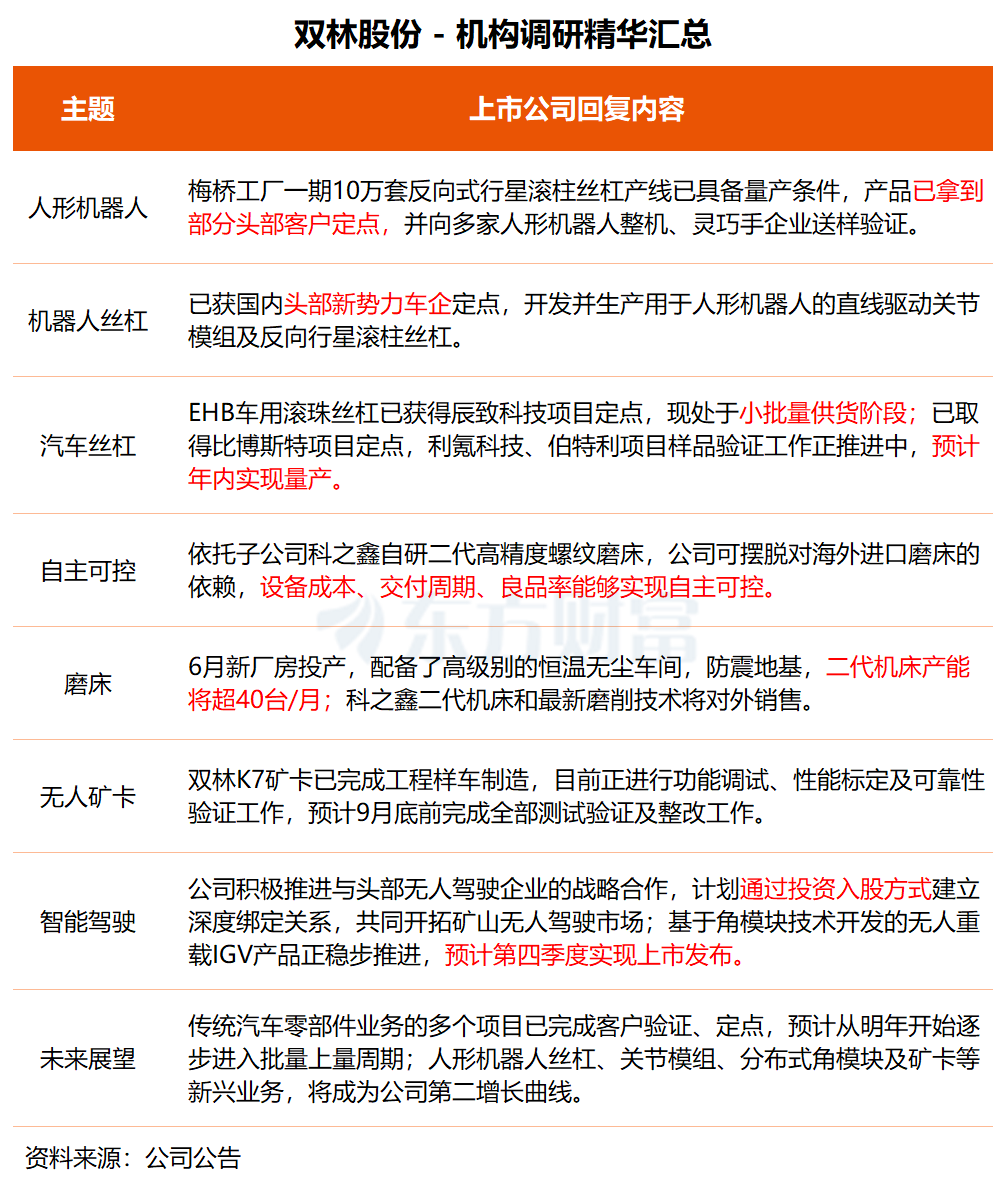 资料显示,双林股份是国内汽车精密零部件企业,正依托传动工艺优势布局人形机器人及智能矿山。

E | 财报显示,公司上半年实现营业收入21.26亿元,归母净利润9147.82万元,扣非净利润7812.39万元,毛利率为20.78%。

F | 利润承压主要因汽车价格竞争及创新业务研发加码。 二级市场方面,双林股份今日收涨0.47%。 爱迪特:公司正积极筹备参与第二轮种植体集采 爱迪特近日举行业绩说明会,与中金公司、高盛亚洲等机构互动交流。

G | 爱迪特表示,公司依托自身材料板块的竞争优势,布局研发具备全球竞争力的3D打印材料及设备,后续将进一步强化材料与设备的业务协同,助力相关业务发展。 财报显示,公司上半年境外收入4.3亿元,同比增长31.41%,其中,口腔修复材料收入4.07亿元,同比增长13.57%,毛利率60.43%,同比提升2.23个百分点,主要得益于国产替代效应释放及产线自动化升级。口腔数字化设备收入1.36亿元增41.81%。汇兑损失约2093万元,剔除退税和汇兑后,主业盈利优于报表水平。 海外市场方面,公司将分区域实施差异化策略,欧美成熟市场加大重点大客户覆盖提升客单价,南美、中东、非洲等新兴市场深化本土化布局。

H | 同时,公司将稳步推动3D Pro Zir Ultra对3D Pro Zir的替代,依托国产材料替代优势改善盈利水平,持续提高海外市场高端产品销售占比。 公司还介绍,上半年种植体业务实现一定增长,海外增长突出,中东、东南亚增速较快;国内方面,正筹备第二轮种植体集采。公司将重点布局数字化种植赛道,种植机器人将作为数字化种植整体解决方案的重要配套同步推进。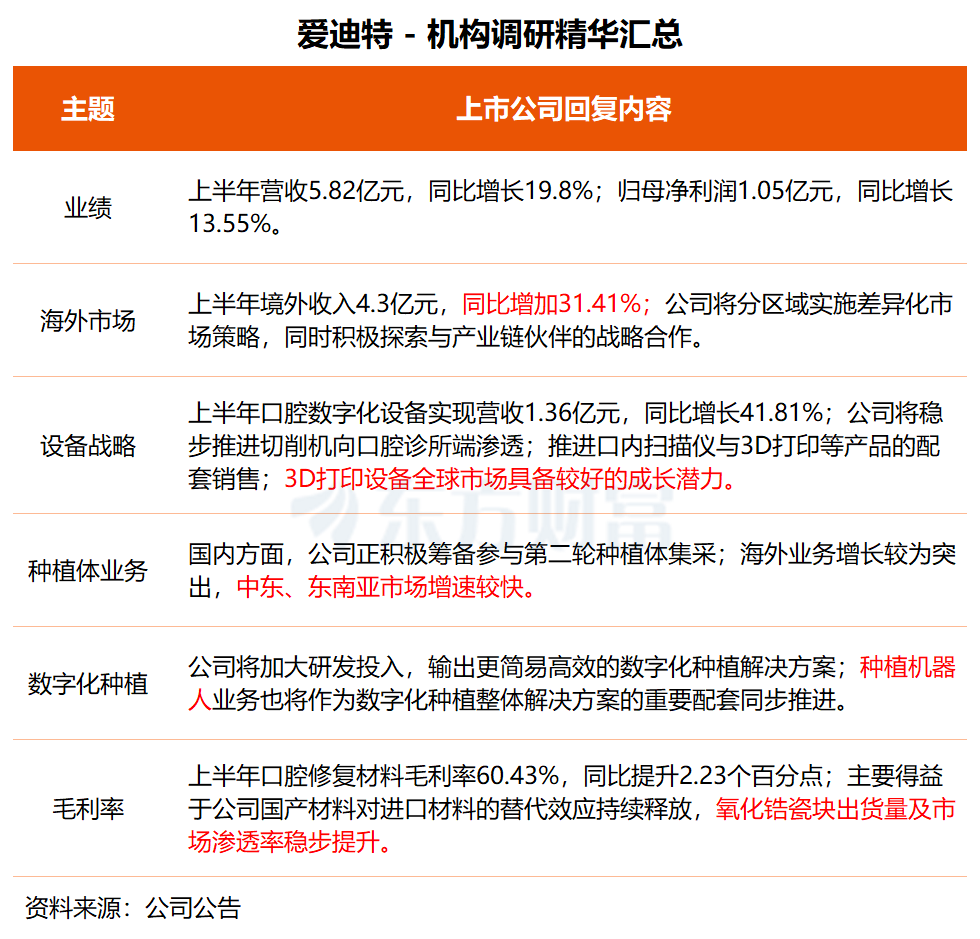 资料显示,爱迪特是行业领先的口腔修复材料及口腔数字化设备提供商,并通过海外多家子公司本土运营,在欧美市场获得较高的市占率和品牌知名度。 二级市场方面,爱迪特作为口腔医疗+国产替代标的,股价随消费医疗板块整体表现运行,公司今日收涨9.35%,近5个交易日涨10.35%。
 (文章来源:东方财富研究中心)。

I |
Current article:http://w5p43iu.yindabobiehonggaonumiao.bond/list_lid/c7ax.html
Published on:08:13:38